⚡ Quick answer:
Choose a non-WiFi monitor if privacy, reliability, and simplicity matter most — no hacking risk, works during internet outages, no subscriptions, and nothing to set up beyond plugging it in.
Choose a WiFi monitor if you need to check on baby from outside the house, want sleep tracking and smart alerts, or travel and want to monitor from anywhere with your phone.
As an Amazon Associate we earn from qualifying purchases. How we research.
WiFi vs Non-WiFi Baby Monitor: Which Should You Buy? (2026)
Shopping for a baby monitor in 2026 means choosing between two fundamentally different technologies: WiFi monitors that stream to your phone through the internet, and non-WiFi monitors that transmit directly to a dedicated parent unit over a private radio signal. Both have loyal fans, and the right choice depends entirely on how you live.
We compared the two types across privacy, reliability, features, and cost, drawing on current product specs (verified October 2026), verified-purchase reviews, and parent forums — not marketing claims. Below you’ll also find our top non-WiFi picks for parents who’ve already decided.
How Each Type Works
Non-WiFi monitors use a closed radio link (usually 2.4GHz FHSS — frequency-hopping spread spectrum) between the nursery camera and a dedicated parent unit with its own screen. Pairing is one-to-one: each camera talks only to its monitor. There’s no router, no app, no cloud, and no account to create. Turn both on and they connect in seconds.
WiFi monitors connect the camera to your home WiFi network, then stream encrypted video to an app on your phone — locally at home and remotely from anywhere with internet. Many add cloud recording, sleep analytics, breathing or movement tracking, and smart notifications (“baby woke up”). The tradeoff: they need your router, your phone, and (often) a subscription to work at full capability.
Privacy & Security
This is the number-one reason parents choose non-WiFi. A closed-circuit FHSS system can’t be reached from the internet — there’s simply no network path for a stranger to follow. Infant Optics’ own product pages describe this as “hack-proof” because the video feed is only viewable on the paired parent unit. There’s a reason privacy-focused parents (and many pediatric sleep consultants) keep recommending them.
WiFi monitors are not inherently unsafe — reputable brands use encrypted streams — but they expand your attack surface: the camera joins your home network, video may pass through the vendor’s cloud, and weak or reused passwords are the most common real-world breach vector. If you go WiFi, use a strong unique password, enable two-factor authentication where offered, and keep firmware updated.
Bottom line: if the thought of your baby’s video touching the internet bothers you, non-WiFi removes the question entirely.
Reliability: What Happens When Things Break
Internet outage: Non-WiFi monitors don’t care — camera talks to parent unit directly, storm or no storm. WiFi monitors that depend on cloud servers can go dark or lose remote viewing during outages (some keep local streaming; check the fine print).
Interference: This one cuts both ways. Non-WiFi FHSS monitors share the 2.4GHz band with your router, microwave, and Bluetooth — most modern units hop frequencies to dodge interference, but in a crowded apartment building some owners still report occasional static. WiFi monitors suffer the same congestion plus router quirks (band steering, mesh handoffs).
Range: Dedicated non-WiFi units typically advertise 700–1,000 ft of open-air range, which translates to solid whole-house coverage. WiFi monitors are limited by your router’s reach inside the house — but unlimited outside it.
Phone dependence: A non-WiFi parent unit is always on, always charged (or charging), and never interrupted by a phone call. WiFi monitoring lives on the same device that rings, runs out of battery, and gets left in the kitchen.
Features: What You Gain and Lose
WiFi wins on features. App-based monitors offer remote viewing from anywhere, multiple viewers (both parents, grandparents), cloud video history, sleep tracking and analytics, breathing/movement monitoring, and smart alerts pushed to your phone. If you want data about your baby’s sleep, WiFi is the only game in town.
Non-WiFi wins on the fundamentals. The best dedicated units — like the Infant Optics DXR-8 Pro below — offer pan/tilt/zoom cameras, 5–7″ HD screens, two-way talk, temperature sensors, night vision, lullabies, and VOX (sound-activated screen wake). What you don’t get: remote viewing, sleep analytics, or app alerts. What you also don’t get: accounts, updates, or subscription prompts.
The screen question matters more than people expect. Staring at a dedicated 5–7″ parent unit all evening is genuinely pleasant; staring at your phone’s baby-monitor app drains your battery and keeps you one notification away from doomscrolling. Many parents end up preferring the “dumb” screen.
Cost: Upfront and Over Time
Quality non-WiFi monitors sit in the low-hundreds with no ongoing costs — buy it once, use it for years, resell it after. WiFi monitors often start at a similar upfront price, but subscriptions change the math: several popular WiFi brands charge a monthly fee for full features (video history, sleep insights, multiple users). Over two years of use, a modestly priced WiFi monitor can quietly cost double its sticker price. Check the subscription terms before you fall in love with the hardware.
Resale is another quiet factor: non-WiFi monitors hold value well on the secondhand market because there’s no account to transfer and no subscription to inherit.
Which Should You Buy? A Simple Decision Guide
So, wifi vs non-wifi baby monitor — which should you buy? If privacy matters most, a non-wifi baby monitor is the safer pick. If you want remote viewing, a wifi baby monitor wins. Our wifi vs non-wifi baby monitor comparison above breaks down every difference.
Buy non-WiFi if:
- Privacy is a top concern — you want zero internet exposure
- You want something that works during power/internet outages (on battery)
- You hate subscriptions and accounts for baby gear
- Grandparents or caregivers will use it — a dedicated unit is foolproof
- You travel to places with unreliable WiFi (cabins, grandparents’ houses)
Buy WiFi if:
- You want to check on baby from work, the gym, or anywhere outside the house
- Sleep tracking, breathing monitoring, or smart alerts matter to you
- Multiple caregivers need simultaneous access on their own phones
- You’re comfortable managing passwords, updates, and possibly a subscription
Can’t decide? Ask yourself one question: “Will I ever need to see the nursery when I’m not home?” If the answer is no — and for most families with a parent home at night, it’s no — non-WiFi is simpler, cheaper over time, and more private.
Our Top Non-WiFi Picks (2026)
Decided on non-WiFi? These are the three dedicated monitors we’d recommend right now, based on current specs, owner-review sentiment, and category standing on Amazon. For the full deep-dive comparison, see our roundup: Best Non-WiFi Baby Monitors (2026).

1. Infant Optics DXR-8 Pro — Best Overall Non-WiFi Monitor
The DXR-8 Pro is the non-WiFi monitor everything else gets measured against: a 5″ 720p HD display, patented Active Noise Reduction (filters out fans and white-noise machines so you hear the baby, not the room), pan/tilt/zoom with interchangeable lenses, and a closed-circuit FHSS connection Infant Optics markets as hack-proof. With thousands of reviews averaging 4.5 stars and a top-15 spot in Amazon’s video-monitor category, it’s the safest recommendation in this space. If you want the one non-WiFi monitor that “just works” for years, this is it.
As an Amazon Associate we earn from qualifying purchases.
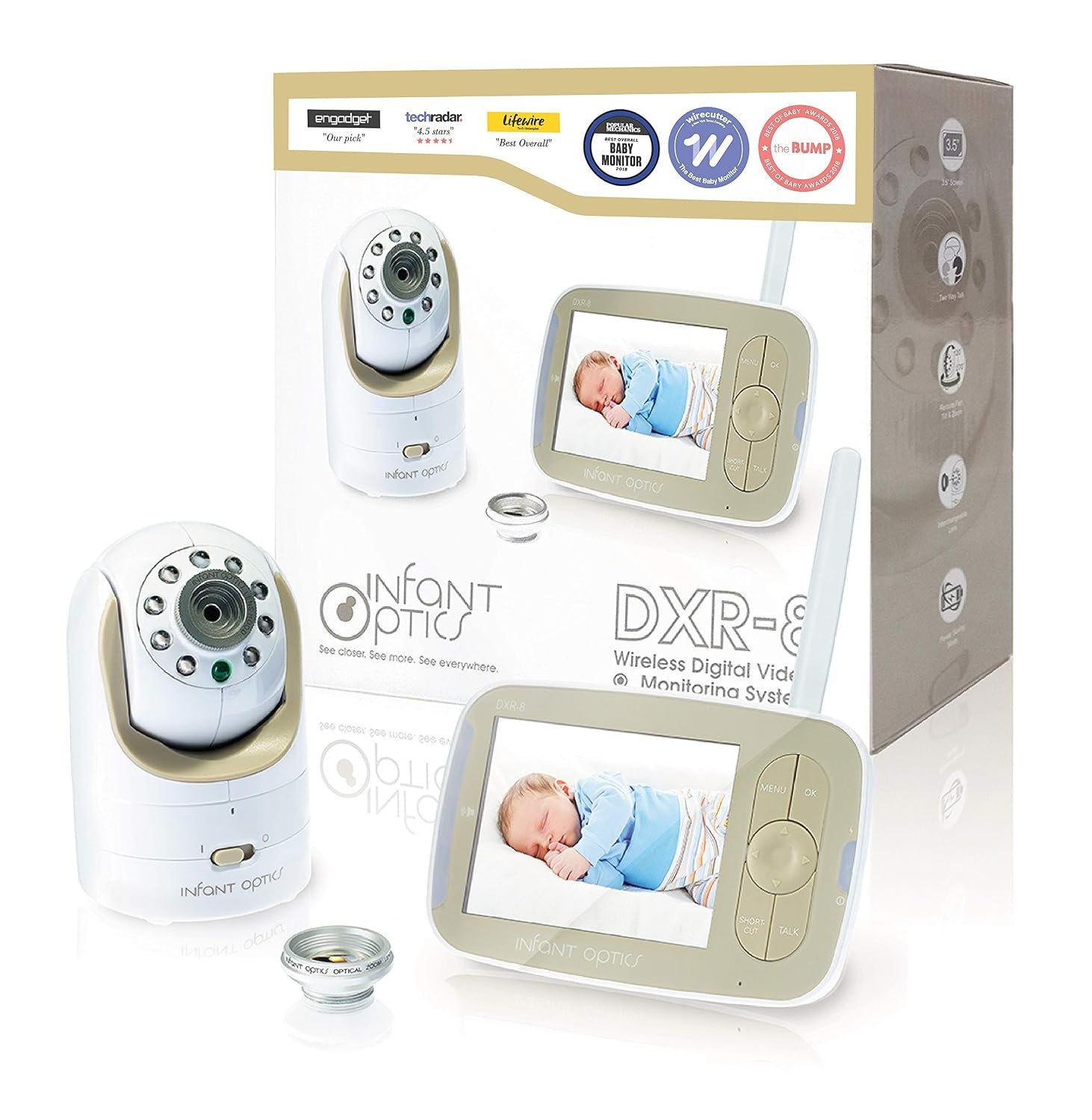
2. Infant Optics DXR-8 — The Proven Classic
The original DXR-8 is the monitor that built this category — tens of thousands of Amazon reviews over more than a decade, with a 3.5″ screen, interchangeable optical lenses, remote pan/tilt/zoom, two-way talk, and temperature monitoring. It lacks the Pro’s HD screen and noise reduction, but it costs meaningfully less and its reliability record is unmatched: many owners report theirs running for 3+ years across multiple kids. A smart buy if the Pro’s premium feels steep.
As an Amazon Associate we earn from qualifying purchases.
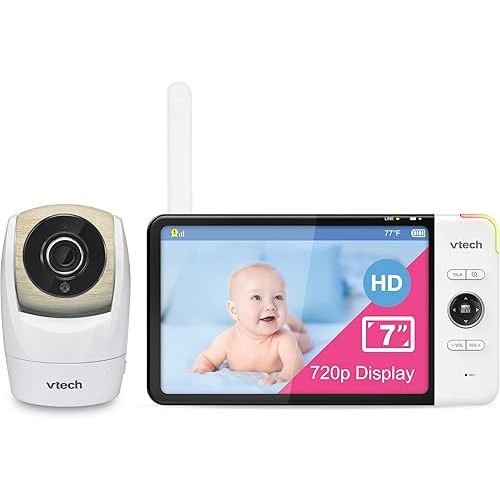
3. VTech VM919HD — Biggest Screen for the Money
The VM919HD’s headline is the largest screen in its class: a 7″ 720p HD display — noticeably easier on tired eyes than 3.5–5″ rivals. It adds 360° panoramic viewing, a 110° wide-angle lens, up to 15 hours of video streaming on its 5,000mAh battery, 1,000 ft range, VOX sound-activated wake, temperature alerts, and 5 lullabies plus white noise — all over a secure no-WiFi FHSS link. The tradeoff vs. Infant Optics: it’s not expandable (no add-on cameras), and some owners note the bulkier parent unit. For screen size per dollar, nothing non-WiFi touches it.
As an Amazon Associate we earn from qualifying purchases.
Want the full comparison with more models, range tests, and battery-life notes? Read our dedicated roundup: Best Non-WiFi Baby Monitors (2026).
Frequently Asked Questions About WiFi Baby Monitors
Can non-WiFi baby monitors be hacked?
Effectively no — closed-circuit FHSS monitors have no internet connection to attack. The theoretical risk is someone nearby with radio equipment intercepting the signal, but frequency-hopping makes this impractical, and no mainstream exploit has ever been demonstrated against these systems.
Do non-WiFi monitors work without internet?
Yes — that’s their core advantage. The camera talks directly to the parent unit over its own radio link, so they work during internet outages, in rural cabins, and anywhere with a power outlet (plus battery backup in the parent unit).
Can I view a non-WiFi monitor on my phone?
Not directly — that’s the tradeoff. If remote phone viewing matters (checking from work, travel), you need a WiFi monitor or a hybrid. Some parents run both: non-WiFi for nightly use, a cheap WiFi camera for daytime check-ins.
What’s the range of a non-WiFi baby monitor?
Most advertise 700–1,000 feet of open-air range. Indoors, walls cut this significantly — expect reliable coverage across a typical house and yard, but test your specific layout (thick concrete or metal can be trouble).
Are WiFi baby monitors safe to use?
They’re reasonably safe if you practice basic hygiene: strong unique password, two-factor authentication where available, and firmware updates. The risk isn’t Hollywood-style hacking — it’s credential reuse and unpatched vulnerabilities. Non-WiFi simply sidesteps the issue.
Do non-WiFi monitors have monthly fees?
No — there are no subscriptions, accounts, or cloud fees. You buy the hardware once and it works until it wears out, which is part of why they’re cheaper over a typical 2–3 years of use.
Final Verdict: WiFi vs Non-WiFi Baby Monitor
For most families, a non-WiFi monitor is the better buy: more private, more reliable during outages, no subscriptions, and dead simple for every caregiver to use. The Infant Optics DXR-8 Pro is the non-WiFi pick we’d recommend first, with the VTech VM919HD as the big-screen value alternative. After comparing all the options, this remains our top recommendation for the best wifi baby.
Choose WiFi only if you genuinely need remote viewing or smart features like sleep tracking — and go in with eyes open about subscriptions. Either way, compare the full non-WiFi field in our roundup: Best Non-WiFi Baby Monitors (2026).
As an Amazon Associate we earn from qualifying purchases. Prices and availability change frequently — see Amazon for the latest.
How we researched: We compared current product specifications from Amazon listings (verified October 2026), aggregated owner feedback from verified-purchase reviews and parent forums, and evaluated privacy claims against how each technology actually works. We did not receive free products from any brand. Last updated: October 13, 2026.
Manufacturer resources for baby monitors: Infant Optics, VTech.